 Docs
DLL Personalizada
En algunos casos, es necesario programar funcionalidades que flexygo no tiene. Para esto, es posible personalizar nuestras propias DLLs. Es necesario:
- Crear una nueva biblioteca de clases de C# para .NET 9 (
net9.0, la misma versión que las bibliotecas de flexygo), por ejemplo condotnet new classlib -f net9.0. -
Agregar la referencia al paquete NuGet Flexygo.Library, que trae las bibliotecas de flexygo (Tabla 1). Usa la misma versión de flexygo que tiene la aplicación:
| Tabla 1. Algunas bibliotecas de flexygo incluidas en el paquete | ||
|---|---|---|
| flxDataManager | flxEntity | flxGlobals |
| flxLocalization | flxMail | flxObjectConfig |
| flxSession | flxSettings | flxUtilities |
-
Ver el código de ejemplo en C#:
Función de insertar, actualizar y eliminar objeto Proceso de objeto con parámetros Proceso de objeto sin parámetros Proceso de colección con parámetros * Proceso de colección sin parámetros * Cargar objeto o cambiar propiedad Los métodos tienen que ser
public static. flexygo pasa cada parámetro del proceso por su nombre, además deEntityyRet.No olvide configurar el Identificador Único en la configuración del objeto
-
Compilar la DLL personalizada y copiarla en la carpeta
custom/bindel Backend (en el proceso, el fichero se indica como~/custom/bin/MiLibreria.dll;~es la carpeta del Backend). - Configurar su proceso dentro de flexygo, visualizar imagen (Imagen 1.)
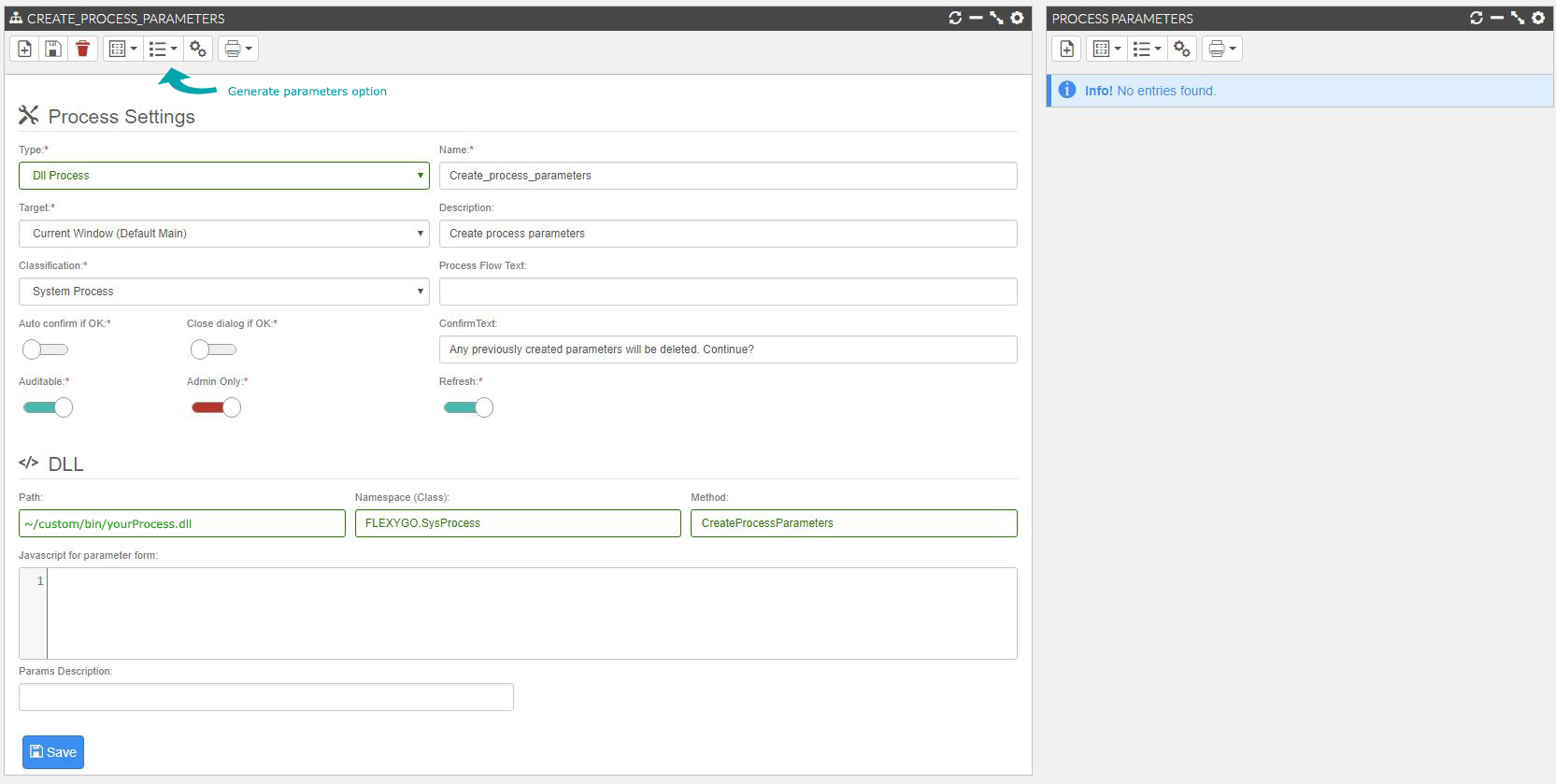
C# Personalizado
Los procesos de C# embebidos sirven para el mismo propósito que los procesos de DLL personalizadas.
Las referencias a bibliotecas y el código del proceso se insertan directamente en el formulario de flexygo (Imagen 2.)
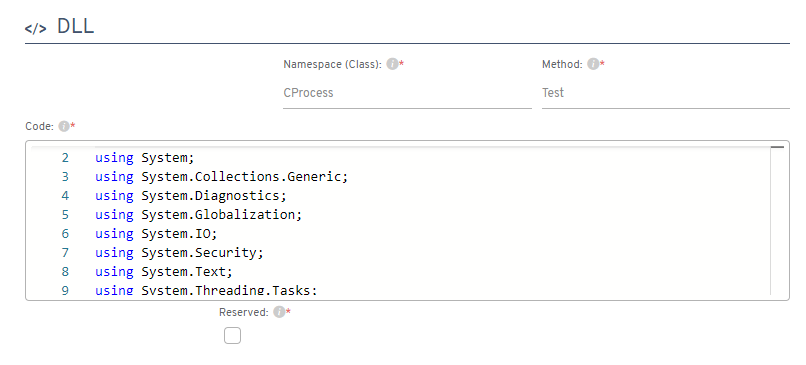
Cuando guardas tu proceso C# en flexygo, se compila para verificar si hay errores.
Para comenzar a depurar un proceso C#:
- Activa el ajuste DebugProcesses: panel de control → área Entorno → Parámetros, grupo Sistema (en la skin flexy2022: Admin Work Area > Environment > Settings).
- Para establecer un punto de interrupción en una ubicación específica de tu código C#, puedes insertar:
Esto abrirá el código C# generado en Visual Studio, permitiéndote depurar el proceso.
/// <summary>
/// Sample object process executed from object with params
/// </summary>
/// <param name="Entity">The entity.</param>
/// <param name="Ret">Returns a Process Helper.</param>
/// <param name="Param1">Sample string param</param>
/// <param name="Param2">Sample integer param</param>
/// <returns><c>true</c> if no error, <c>false</c> otherwise.</returns>
public static bool SampleUserProcessWithParams(EntityObject Entity, ref ProcessHelper Ret, string Param1, int Param2)
{
    try
    {
        // Do something

        Ret.Success = true;
        Ret.SuccessMessage = "Process finished";
        return true;
    }
    catch (Exception ex)
    {
        Ret.Success = false;
        Ret.LastException = ex;
        return false;
    }
}
using System;
using System.Data;
using FLEXYGO.Exceptions;
using FLEXYGO.Objects;
using FLEXYGO.Objects.Settings;
using static FLEXYGO.Processing.ProcessManager;

namespace MyCompany.Processes
{
    public class SampleDataProcesses
    {
        /// <summary>
        /// Insert new object
        /// </summary>
        /// <param name="Entity">User Entity object with all info</param>
        /// <param name="Ret">ProcessHelper for returning results</param>
        public static bool InsertObj(EntityObject Entity, ref ProcessHelper Ret)
        {
            try
            {
                if (!Entity.CanInsert)
                {
                    Ret.LastException = new LocalizedException("You do Not have enough credentials to insert this Object.");
                    return false;
                }

                // Do something here before insert

                if (Entity.InsertProcess(Entity.TableName, ObjectSettings.eUpdateType.Standard, ""))
                {
                    // Do something here after insert

                    Ret.Success = true;
                    return true;
                }
                else
                {
                    Ret.Success = false;
                    Ret.LastException = Entity.LastException;
                    return false;
                }
            }
            catch (Exception ex)
            {
                Ret.Success = false;
                Ret.LastException = ex;
                return false;
            }
        }

        public static bool UpdateObj(EntityObject Entity, ref ProcessHelper Ret)
        {
            try
            {
                if (!Entity.CanUpdate)
                {
                    Ret.LastException = new LocalizedException("You do Not have enough credentials to update this Object.");
                    return false;
                }

                DataTable lTabla = Entity.GetData.Tables[0].GetChanges();

                // string OldValue = lTabla.Rows[0]["my_data_field", DataRowVersion.Original].ToString();
                // string NewValue = lTabla.Rows[0]["my_data_field", DataRowVersion.Current].ToString();
                // Use this syntax to compare old and new values

                // Do something here before update

                if (Entity.UpdateProcess(ObjectSettings.eUpdateType.Standard, ""))
                {
                    // Do something here after update

                    Ret.Success = true;
                    return true;
                }
                else
                {
                    Ret.Success = false;
                    Ret.LastException = Entity.LastException;
                    return false;
                }
            }
            catch (Exception ex)
            {
                Ret.Success = false;
                Ret.LastException = ex;
                return false;
            }
        }

        public static bool DeleteObj(EntityObject Entity, ref ProcessHelper Ret)
        {
            try
            {
                if (!Entity.CanDelete)
                {
                    Ret.LastException = new LocalizedException("You do Not have enough credentials to delete this Object.");
                    return false;
                }

                // Do something here before delete

                if (Entity.DeleteProcess(Entity.TableName, ObjectSettings.eUpdateType.Standard, ""))
                {
                    // Do something here after delete

                    Ret.Success = true;
                    return true;
                }
                else
                {
                    Ret.Success = false;
                    Ret.LastException = Entity.LastException;
                    return false;
                }
            }
            catch (Exception ex)
            {
                Ret.Success = false;
                Ret.LastException = ex;
                return false;
            }
        }
    }
}
using System;
using FLEXYGO.Objects;
using static FLEXYGO.Processing.ProcessManager;

namespace MyCompany.Processes
{
    public class SampleUserProcesses
    {
        /// <summary>
        /// Sample collection process executed from collection
        /// </summary>
        /// <param name="Entity">The entity collection.</param>
        /// <param name="Ret">Returns a Process Helper.</param>
        /// <returns><c>true</c> if no error, <c>false</c> otherwise.</returns>
        public static bool SampleUserProcess(EntityCollection Entity, ref ProcessHelper Ret)
        {
            try
            {
                foreach (EntityObject obj in Entity)
                {
                    // Do something
                }

                Ret.Success = true;
                return true;
            }
            catch (Exception ex)
            {
                Ret.Success = false;
                Ret.LastException = ex;
                return false;
            }
        }
    }
}
/// <summary>
/// Sample collection process executed from collection with params
/// </summary>
/// <param name="Entity">The entity collection.</param>
/// <param name="Ret">Returns a Process Helper.</param>
/// <param name="Param1">Sample string param</param>
/// <param name="Param2">Sample integer param</param>
/// <returns><c>true</c> if no error, <c>false</c> otherwise.</returns>
public static bool SampleUserProcessWithParams(EntityCollection Entity, ref ProcessHelper Ret, string Param1, int Param2)
{
    try
    {
        foreach (EntityObject obj in Entity)
        {
            // Do something
        }

        Ret.Success = true;
        return true;
    }
    catch (Exception ex)
    {
        Ret.Success = false;
        Ret.LastException = ex;
        return false;
    }
}
/// <summary>
/// Sample load object/change property custom process.
/// </summary>
/// <param name="aSender">FormSender with objectname, processname or reportname, entity if proceeded and current form values.</param>
/// <param name="Ret">Returns a Process Helper.</param>
/// <returns>List of FormAction with actions to do with properties.</returns>
public static List<FormAction> SampleLoadProcess(FormSender aSender, ref ProcessHelper Ret)
{
    try
    {
        // Define new action after load/change
        FormAction action = new FormAction();
        action.PropertyName = "OriginId";

        // Set new value to this property
        action.changeValue = true;
        action.newValue = "1";

        // Change default class to one property
        action.changeClass = true;
        action.newClass = "box-danger";

        // Define if property is required
        action.changeRequired = true;
        action.newRequired = true;

        // Define if property is enabled
        action.changeEnabled = true;
        action.newEnabled = false;

        // Define current visibility to this property
        action.changeVisibility = true;
        action.newVisibility = true;

        // Set new sql for this property
        action.changeSQL = true;
        action.newSQL = "select ObjectName from objects where objectname like '%docu%'";

        // Append to afterload action list
        List<FormAction> actionResult = new List<FormAction>();
        actionResult.Add(action);

        Ret.Success = true;
        return actionResult;
    }
    catch (Exception ex)
    {
        Ret.Success = false;
        Ret.LastException = ex;
        return null;
    }
}
/// <summary>
/// Sample object process executed from object without params
/// </summary>
/// <param name="Entity">The entity.</param>
/// <param name="Ret">Returns a Process Helper.</param>
/// <returns><c>true</c> if no error, <c>false</c> otherwise.</returns>
public static bool SampleUserProcess(EntityObject Entity, ref ProcessHelper Ret)
{
    try
    {
        // Do something

        Ret.Success = true;
        Ret.SuccessMessage = "Process finished";
        return true;
    }
    catch (Exception ex)
    {
        Ret.Success = false;
        Ret.LastException = ex;
        return false;
    }
}